Across the insurance, financial services and healthcare industries especially, businesses are interacting with customers at critical moments in their lives.
The Ultimate Guide to Customer Communication Management Software
Request a Demo
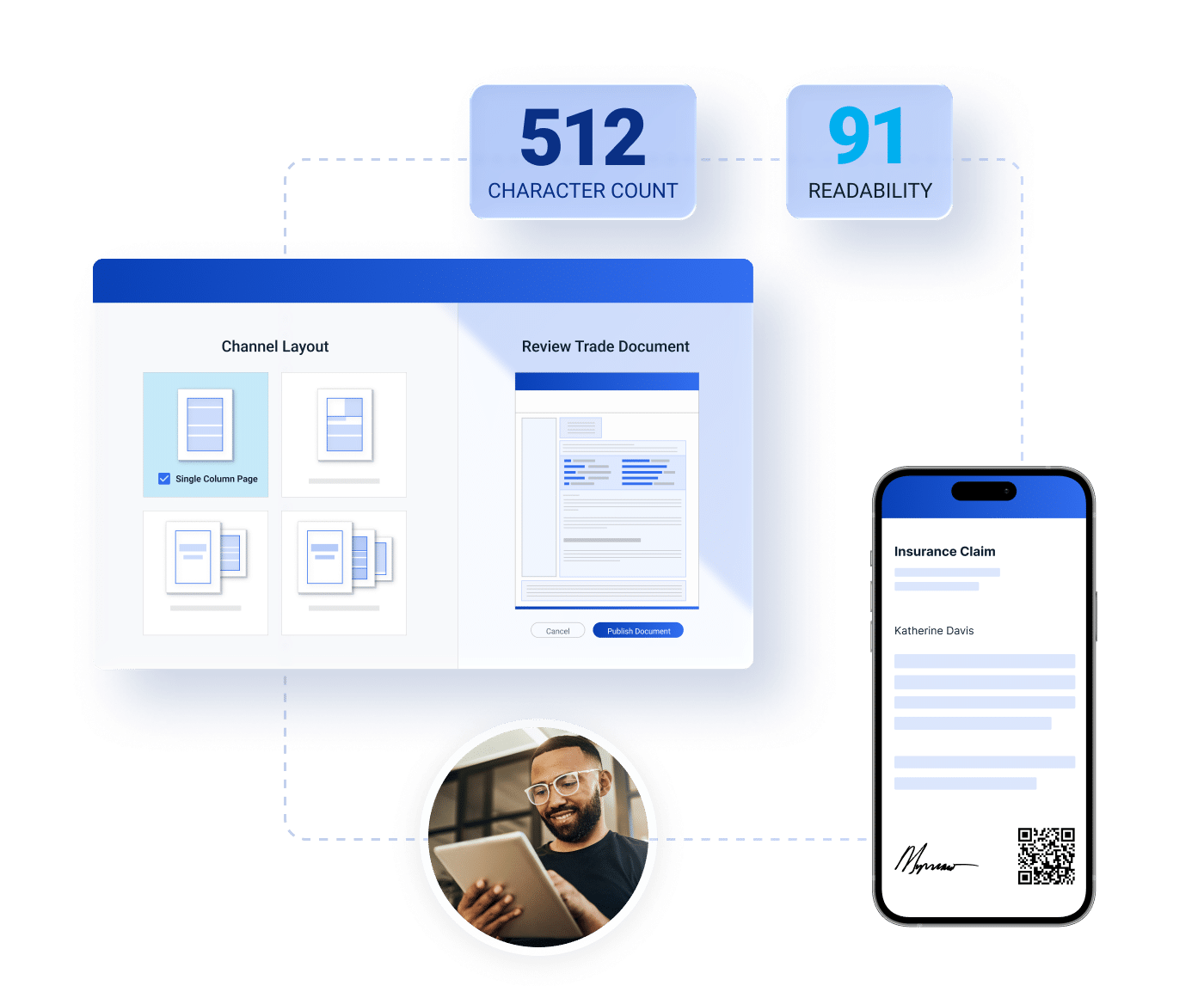

Enterprises around the world are navigating both a digital landscape and customer expectations that are changing faster than ever, leading many businesses to rethink how they interact with customers. Instead of one-way, transactional communications, enterprises must now consider two-way, interactive conversations as a future-proof strategy to communicate with customers.
Whether it’s a car accident, an illness or financially planning for a major life event, today’s customers expect seamless, end-to-end experiences. Unfortunately for many businesses, outdated, legacy CCM systems have created roadblocks and prevented agility, making it even more difficult to meet customers’ growing expectations. Enterprises that adopt pure cloud customer communications management (CCM) software, however, can deliver better customer experiences, and achieve unmatched levels of innovation, agility and scalability.
The Ultimate Guide to CCM Software provides a high-level overview of this type of software and its capabilities, explains the differences between on-premise and pure cloud solutions, highlights how it fits into an enterprise’s technology stack, poses questions to ask when selecting a CCM vendor, and more.
Customer communication management software, also known as customer communications management (CCM) software, helps enterprises create, govern, and deliver high-volume customer correspondence across print and digital channels with consistency, compliance controls, and auditability.
What you’ll learn
- What customer communication management software is and what it is designed to manage
- How CCM supports customer correspondence across regulated communication types
- The capabilities to look for in a CCM platform
- How CCM compares to adjacent tools used for customer communications
- How to evaluate CCM software vendors using structured criteria
Must Have CCM Capabilities

Template and content management with version control
Data-driven personalization using approved content and structured inputs
Workflow automation for recurring correspondence processes
Approvals and governance with role-based controls
Audit trails to support regulated communications
Multi-channel delivery across print and digital channels with consistent standards
Reporting to measure delivery, engagement, and operational outcomes

What is CCM
(Customer Communications Management)?
Customer Communications Management (CCM) technology allows enterprises to effectively interact with their customers across a wide range of channels. Gartner defines CCM as “the strategy to improve the creation, delivery, storage and retrieval of outbound communications,” which includes “new product introductions, renewal notifications, claims correspondence and documentation and bill and payment notifications,” among others.
Why is a CCM solution important?
Getting communications right is crucial, as research from Smart Communications revealed that 81% of global consumers consider communications important to their overall experience with a company. The increasing number of communication channels, coupled with customers’ ever-changing expectations, is putting more pressure than ever on enterprises to ensure customer communications are keeping up with the pace of change.
So, how can enterprises set themselves up for success?
A cloud-based CCM solution that enables enterprises to optimize communications and deliver superior customer experiences provides the flexibility and innovation that legacy, on-premise systems cannot. With a focus on increasing productivity, business leaders should take a hard look at investing in technology that prioritizes agility, speed and scale.
BENCHMARK REPORT
How do consumer preferences measure up to business performance?
Find out in our annual benchmark report:
Download
Trends Driving the Need for
Cloud-Native/Personalized Customer Communications Software
Many factors are converging that are pushing organizations to consider whether or not they have the right technology in place to cater to adjusting consumer demands and business requirements. Here are a few of examples:
Regulatory Changes
Regardless of where your organization is located, the chances are that you’re under constant pressure to adjust and react to changing industry, state/regional, or regulatory body changes that impact how you communicate with your customers. And, the pace of these changes isn’t slowing down. Having the right CCM technology in place not only allows you to remain compliant, but also to adjust to these changes quicker. Some recent examples of regulatory changes include:
- Changes governing mandates to be able to provide communications across languages that are present in a specific country/region/state
- Changes governing providing communications that don’t exceed a specific reading level
- Guidance—particularly around financial communications—on ensuring that communications are clear, concise and easy to understand.
- Regulation around ensuring that communications are in accessible formats and able to be consumed by a broad range of the population
- Time-bound regulations demanding a response to specific actions or processes within a specific time period (like appeals, grievances, prior authorizations)
Focus on Agility
Organizations are over-indexing their strategic priorities ad nauseam in order to achieve more agility. Being able to pivot or change processes in response to supply-chain disruptions, global pandemics, environmental catastrophes all while maintaining business continuity is of paramount importance. This level of agility often demands different technologies – cloud-based technologies that have the ability to shield an organization from some of these disruptions, for instance.
AI Readiness
While GenAI is the buzzword on everyone’s lips, AI technology has been around for quite some time. As organizations grapple with how, and if they want to be able to harness these burgeoning technology innovations, they’re finding that in order to achieve success, they will need modern technologies in order to be able to connect to, communicate with, and harness the power of possibilities that this technology provides.
Digital Customer Communications
We’ve seen this trend continue to grow over the past few decades, but the demand for digital communications is not going away, and in some respects is increasing as a result of the recent global pandemic. There will always be customers, or types of communications that will be physically printed and delivered for a number of reason – personal preference, lack of options, verified delivery status etc.. But more and more customers are pushing for digital communication options – maybe not for every touch point with your organization, but some. Modern CCM solutions allow you to control your communication processes and infrastructure regardless of whether or not the end communication is delivered via the mail, or direct to someone’s device.
Focus on the Employee Experience
While a lot of enterprise’s have necessarily turned keen attention to enhancing the customer experience, leading organizations are also spending time thinking about how their own internal employees’ experiences can be enhanced—not only to improve the end customer experience, but also to retain talent. Being forced to work with older, legacy technologies and not being able to solve a customer’s issue due to the technology in place have been two of the biggest complaints by customer-facing employees that become significantly ameliorated through the use of modern CCM solutions.



Benefits of Pure Cloud CCM Software
As enterprises weigh their options for customer communications software, they will be faced with on-premise, hybrid cloud and pure cloud solutions.The best way for companies to meet their customer experience goals in both the near and long term is to invest in cloud-based solutions that optimize customer communications. To succeed, the technology they employ today must be equipped to evolve and scale as customers’ needs and business priorities change over time. Unfortunately, legacy, on-premise tools – or even legacy systems that are now managed in the cloud – were designed simply to distribute outbound communications and as a result have struggled to adapt to the nuances of today’s omnichannel customer.
Disadvantages of Legacy Systems

Unable to provide speed or agility
Little to no business user control
Higher total cost of ownership (TCO)
Suboptimal customer experience
Advantages of Pure Cloud CCM Solutions

Seamless integrations
Complete view of the customer
Rapid response times
Omnichannel communications
Still need convincing? Below are some of the key benefits of cloud-based CCM software:

Speed and Agility. Connect to other mission-critical business applications to create
a flexible ecosystem and allow internal stakeholders to take advantage of new technology with shorter ramp-up times.

Business User Control. Empower business users to have more control over the communications process and avoid IT reliance and lengthy delays.

Reduced Total Cost of Ownership. Reduce TCO through platform consolidation, elimination of hardware and software costs associated with on-premise and legacy applications and scaling on demand versus building for peak volume capacities.

Enhanced Customer Experiences. Rapidly deploy new products, solutions, services and communication channels to meet changing customer demands and market shifts.

Seamless Integrations. Avoid extensive integrations and legacy systems being overcome by publishing APIs. Plug-and-play accelerators enable disparate systems to communicate and trigger faster responses.

Consistent Innovation. Take MVPs and proof of concepts into production in days or weeks instead of years and experience agility and rapid time-to-market.

Enhanced Business Continuity. Better equip businesses to respond and adjust in times of crisis and minimize disruptions to day-to-day operations.
EBOOK
Ready to make the move to the cloud?
This ebook explores how large enterprises can efficiently and effectively navigate the CCM migration process.
Download
CCM for Customer Correspondence
Customer correspondence refers to communications that customers rely on for decisions, deadlines, and financial or coverage outcomes. Unlike marketing campaigns, correspondence includes time-sensitive, regulated, and often legally required communications such as claims updates, policy documents, statements, billing notices, disclosures, eligibility changes, and explanations of benefits. CCM software helps teams manage this correspondence end-to-end by standardizing templates, controlling approved language, pulling the right data into each message, and applying governance steps before delivery. This reduces rework, lowers compliance risk, and improves consistency across print and digital channels while still allowing personalization where it matters.
Common correspondence types in regulated industries:

Insurance
Claims communications, policy documents, renewals, billing and payment notices, regulatory notices.

Finance
Onboarding and verification, statements, servicing notices, fraud alerts, disclosures.

Healthcare
Claims communications, policy documents, renewals, billing and payment notices, regulatory notices.
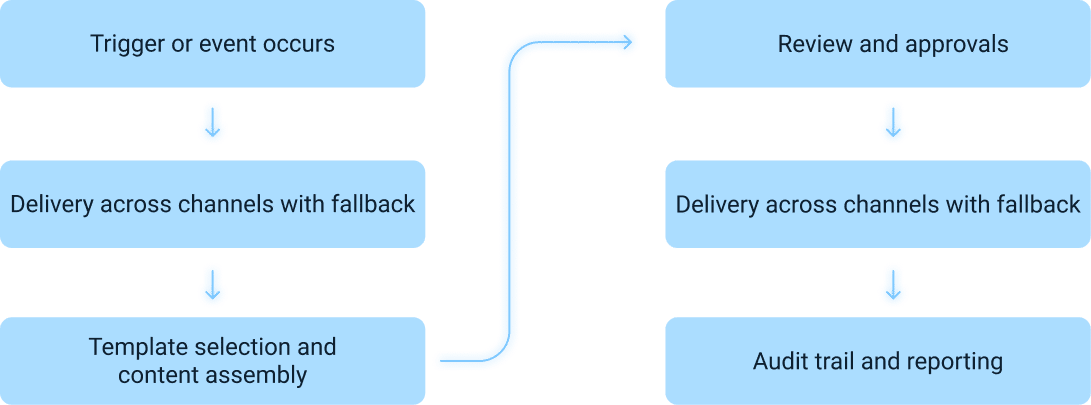
Typical correspondence workflow in CCM
Checklist for Must-have CCM Software Features & Capabilities
When exploring options for CCM software, it’s important to keep several priorities in mind. Everything from integrations to security standards must be top of mind. With that said, below is a checklist of must-have features and capabilities for a modern CCM solution.
Capabilities

Deliver personalized, relevant communications that maintain brand standards and improve outcomes
Handle the complex nature of critical business communications
Manage templates to account for different channels, brands and jurisdictions
Create and share content across different users to ensure consistency
Allow customers to initiate interactions
Deliver interactive, omnichannel communications across web, email, SMS, print and more
Generate both one-time, on-demand and large batch communications
Connect and leverage existing customer data
Provide business users with more control
Create pre-approved templates for faster review and approvals
Access available to a dispersed workforce and across browsers
Integrations
Integrating a CCM solution with common business applications allows business users to be more agile, efficient and less dependent on IT resources. Enterprises should seek a CCM vendor that provides rapid integrations to common business applications through APIs.
Common technology solution integration partners include:
E-signature
ECM
CRM
BPM
AI
In addition to technology solutions partners, system integrators provide advisory, managed and implementation services. Top-tier CCM vendors partner with companies like Capgemini, Cognizant, Deloitte and more to provide these services.
Visit the Conversation Cloud™ Marketplace
Learn more about how we empower organizations like yours to build meaningful customer experiences quickly.
Explore Marketplace
Security
Enterprises should seek out a vendor with the most rigorous standards for security and data privacy, including:
A model in which system administrators can specify which functions a business user can perform based on their role and which resources a user can access based on group membership
The ability to apply permissions to CMS folders that limit access to particular users or groups
A robust information security program, including PCI DSS, SOC 1 and SOC 2, HIPAA, ISO/IEC 27001 certifications, IRAP and more
CCM Software Compared
CCM software vs. document generation tools
Document generation typically focuses on producing an output from a template. CCM software manages the full communication lifecycle, including content governance, workflow approvals, version control, channel delivery, and auditability. CCM is designed for enterprise-scale correspondence that requires consistency, accuracy, and compliance controls.
CCM software vs. marketing automation
Marketing automation is built for campaigns and engagement journeys primarily owned by marketing. CCM software is built for operational and regulated communications such as statements, notices, disclosures, and service messages. Many organizations use both, with marketing automation supporting campaigns and CCM supporting high-stakes customer communications.
CCM software vs. CRM communications
CRM tools often support agent-driven or transactional communications within service workflows. CCM software standardizes and governs correspondence across the enterprise, especially when multiple systems contribute data and multiple teams contribute content. CCM helps ensure communications remain consistent across channels and business units.
Common Use Cases by Industry
Common correspondence types in regulated industries:
Insurance
● Claims correspondence and status updates
● Policy documents, renewals, and endorsements
● Billing notices and payment communications
● Regulatory notices and required disclosures
● Policy documents, renewals, and endorsements
● Billing notices and payment communications
● Regulatory notices and required disclosures
Finance
● Account onboarding and verification communications
● Statements and servicing notices
● Fraud alerts and resolution communications
● Required disclosures and compliance-driven correspondence
● Statements and servicing notices
● Fraud alerts and resolution communications
● Required disclosures and compliance-driven correspondence
Healthcare
● Explanations of benefits and coverage communications
● Eligibility, enrollment, and plan change notices
● Billing communications and financial responsibility messaging
● Operational service communications related to care and access
● Eligibility, enrollment, and plan change notices
● Billing communications and financial responsibility messaging
● Operational service communications related to care and access
Migrating from Legacy CCM Systems to the Cloud
Supporting today’s always-on customer requires digital transformation, and as businesses rethink the technology they use to engage with customers and deliver on their expectations, migrating from legacy CCM systems to the cloud will be critical.
Migration to a cloud-based CCM software can be a significant investment and can feel like a daunting process. Many of the communications that enterprises send are critical in nature and simply cannot be turned off. Whether it’s Explanation of Benefits (EOBs), account statements, regulatory disclosures, fraud alerts or something else entirely, essential messages must get to customers when and where they expect them.
This means that enterprises that are replacing home-grown or legacy applications should prioritize a platform that includes a suite of tools designed to make migration easier. Specifically, business leaders should invest in a solution that extracts more than just content. Migration tools should also carry over styling, layout and more.
WEB RESOURCE
Ready to take a tailored approach to solve your company’s CCM modernization needs?
Our CCM migration suite is uniquely designed to help you achieve the right balance of tools and accelerators, allowing you to remove the risks and resource burdens associated with moving to a new solution
View Resource


Questions to Ask a
Potential CCM Solution Provider
Partnering with a particular CCM solution provider is a big choice – there are several options available, but not all of them can provide the same benefits or level or service. So, when making a purchasing decision, it’s important for enterprises to be thorough and ask thoughtful questions to ensure the CCM vendor they choose is the best fit for their organization’s needs and goals.
- How does the platform scale as business needs change over time?
- How does the solution promote agility within the organization?
- Is the platform built using open standards, micro-services and/or APIs?
- Are there hardware requirements?
- How many customers use a single instance of the application?
- How does the solution handle demand fluctuations?
- Does the platform support industry-specific use cases? Are there successful examples of similar companies using the platform?
- Does the provider offer Service Level Agreements (SLAs)?
- What is the Total Cost of Ownership (TCO) for implementing and maintaining the solution?
- How often is the solution upgraded and what does that process entail?
- How does the solution provider address local regulatory needs and keep data in country of residence?
- How does the vendor address security and data privacy?
- How fast is the implementation process?
- How fast does the solution adapt to new communication channels or other demands?
- How well does the CCM solution integrate with other business-critical solutions?

Tips for Effective Customer Communications Management
Business leaders around the world are challenged with creating exceptional experiences while customers’ expectations are constantly evolving. While this can feel challenging, having the right CCM software in place enables businesses to meet the customer needs of today while also laying the foundation for a successful future.
Below are a few tips for effective CCM that will equip enterprises to deliver exceptional customer experiences and create competitive differentiators.
1.Deliver Omnichannel Communications
Today, every customer interaction is an opportunity to shape their overall experience with a company. With a growing number of communication channels – like SMS, WhatsApp, in-app messaging, and more – customers expect to be able to initiate conversations with a business. Unfortunately, many businesses deliver siloed, multichannel communications – where several channels are available but operate separately. This leads to a lack of personalization and disjointed customer experiences. A true omnichannel communications strategy puts the customer – not the business – at the center and orchestrates conversations across channels. Customers can seamlessly move from one channel to another – providing richer, deeper, and more engaging digital experiences.
2.Provide Personalized, Tailored Interactions
Recent research indicated that more than 40% of consumers feel that lack of personalization in communications leads to frustration with a company. Providing tailored, personalized interactions leads to a more seamless – and superior – experience.
It’s important to remember that today’s customers expect personalization to go beyond just their name or other demographic data. Enterprises must demonstrate that the data they have provides an excellent customer experience and is being used in a way that informs future interactions. Further, businesses should continue to monitor customer behavior to continuously improve digital experiences and provide meaningful, effective outcomes.
3.Offer an Always-On Experience
In a world where everyone is always on the go and as technology becomes smarter, faster and more intuitive, the ease and efficiency of digital-first customer experiences can’t be beat. Today, however, being just “digitally available” isn’t enough. Instead, enterprises need to focus on tailoring individual interactions to provide a superior, end-to-end customer experience while also automating processes that allow customers to self-guide where possible. This model also allows customers to initiate interactions any time and from any device.
4.Deliver Interactive, Two-Way Conversations
One-way, transactional messages won’t cut it. Today, customers expect personalized, two-way conversations – where data informs future interactions and creates relevant, tailored experiences.
This is where enterprises need to shift from isolated, disjointed transactions to continuous, omnichannel conversations. Effective omnichannel orchestration enables organizations to add digital channels to their print efforts, automate common customer interactions, effectively promote two-way conversations, and more. With two-way messaging across multiple digital channels, businesses can strategically orchestrate conversations across the end-to-end customer experience, ensuring that approved, compliant communications are delivered in real time and initiated when the customer demands them.
5.Scale for the Future
The only way for enterprises to truly succeed moving forward is to adopt a digital-first approach where customer communications management is the cornerstone of the customer experience. For businesses that have already begun their digital journeys, it’s important to continue to evolve and create more sophisticated digital experiences – maturing and scaling over time. A cloud-first, end-to-end Customer Engagement Platform gives businesses the ability to capture information, orchestrate interactions, create personalized communications, and manage the customer experience at scale. By taking incremental steps to improve the customer experience via better communications, businesses will see the needle move when it comes to brand loyalty and customer trust.
GUIDE
To meet communication goals, companies should invest in pure-cloud technology.
While there a lot of options available, not all can provide the benefits of a true cloud-based solution. This buyer’s guide covers why the shift to cloud is so important and questions to ask when seeking the best CCM solution.
Download
Why Partner with Smart Communications for CCM
Smart Communications' Customer Engagement Platform delivers personalized, omnichannel conversations across the entire customer experience. Its core solutions – SmartIQ, SmartCOMM, SmartPATH, and SmartHUB – are designed to modernize the customer journey from communication through storage and retention.
SmartCOMM is a cloud-native CCM software within the Conversation Cloud and enables enterprises to deliver personalized customer communications throughout the entire customer experience. With the enterprise CCM solution, businesses can create and deliver personalized, contextual and compliant communications across customers’ preferred channels at scale.

Navigating Digital Transformation: CCM Migration Success Stories
Explore real-world success stories of organizations mastering CCM migrations with Smart Communications

Learn how the Smart Communications partner network helps businesses more easily achieve their digital transformation and customer experience goals
Choosing the right CCM software is just one part of the process. Whether it’s migration, implementation or ongoing support, the Smart Communications professional services organization consists of experts ready to meet enterprises where they are in their digital transformation journeys.

Get to market faster with Smart Communications professional services
Don’t just take it from us! Smart Communications is consistently ranked as a leader in CCM by industry analysts. For enterprises looking to propel their customer communications management strategy, multiple analysts have noted several key capabilities and differentiators, including:
- The only complete, multi-tenant SaaS CCM solution to deliver enterprise-level scalability in the cloud
- Industry-leading integrations
- Cloud-first strategy to reduce reliance on IT
- Leader in workflow and content automation, as well as enterprise-leading investment in the cloud
A Leading CCM Software
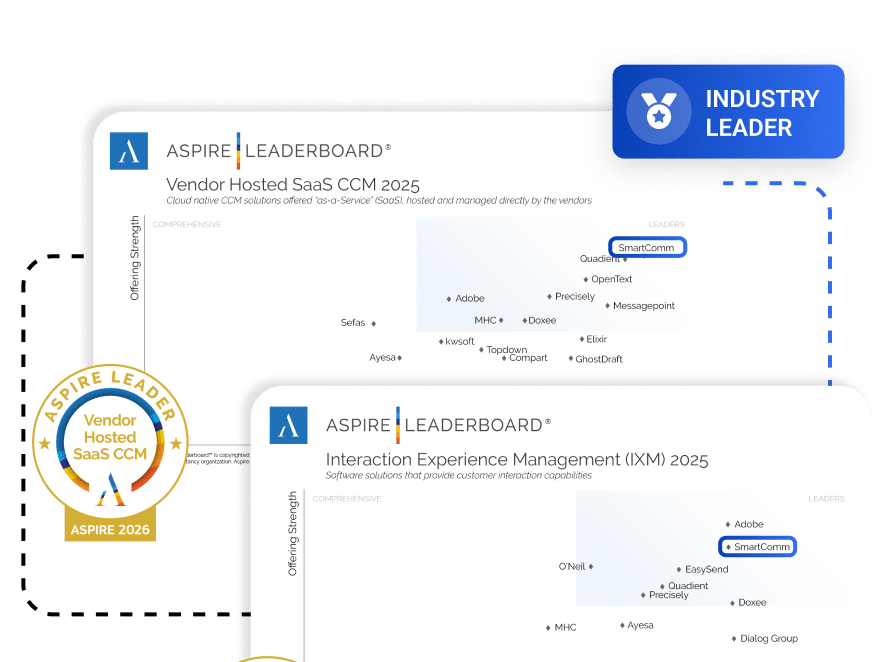
Smart Communications was once again recognized as a leader in Aspire’s most recent leaderboard for customer communications management. Learn more about Smart Communications’ strengths, vision, and more in a complimentary copy of the report.


FAQS
Frequently Asked Questions
When evaluating or implementing document generation software, you likely have a range of questions about functionality, security, compliance, and operational impact. This FAQ addresses the most common inquiries, giving you clear, actionable answers while highlighting the value of modern document generation solutions.
It’s also a condensed version of many sections covered throughout this guide, providing an easy and quick-to-read breakdown for busy executives to skim for pertinent information.
What is customer communication management software?
Is customer communication management software the same as CCM software?
What types of customer correspondence does CCM manage?
What channels can CCM software support?
What features matter most for regulated communications?
How does CCM support approvals, audit trails, and compliance?
How does CCM integrate with CRM and core enterprise systems?
What should we ask when evaluating CCM software vendors?
Are You Ready To Scale the Conversation With Your Customers?
Get in touch with one of our experts today.